



You end most days exhausted but unsure what you actually moved forward. Your calendar was a wall of meetings, your inbox ate three hours, and the one strategic thing that would grow your business got pushed to “tomorrow” for the fifth day running. If that sounds like your week, you do not have a discipline problem. You have a structure problem, and time-blocking fixes it.
Time-blocking is deceptively simple: instead of working from a to-do list, you give every hour of your day a specific job in advance. Founders swear by it because it turns a reactive day into a designed one. Here is exactly how to run the system, the common ways people break it, and how to make it stick past week one.
Why To-Do Lists Quietly Fail Founders

A to-do list tells you what to do. It says nothing about when, or for how long, or what you will not do. So the list grows, the urgent crowds out the important, and the deep work that only you can do keeps losing to whatever is loudest.
Time-blocking forces the decision a list lets you dodge: when will this actually happen? The moment a task has a home on the calendar, it competes for real time instead of floating in a someday cloud. That single shift is why founders who switch rarely go back.
What Time-Blocking Actually Is
Time-blocking means dividing your day into blocks and assigning each block a single focus: writing the investor update from 9 to 10:30, sales calls from 11 to 1, email at 4. You are not just listing tasks; you are pre-deciding when each one gets your attention.
Two close cousins make it stronger. Task batching groups similar work so you are not constantly switching gears, and day theming assigns whole days to a domain, like Mondays for planning and Fridays for admin. Together they cut the mental cost of jumping between unlike tasks, which is where most of your energy silently leaks.
The Step-by-Step System
1. Start with a brain dump
Get every task, commitment, and nagging thought out of your head and into one list. You cannot schedule what you cannot see, and a cluttered mind always overestimates how much fits in a day. Do this weekly, then top it up each morning.
2. Rank by impact, not urgency
Circle the one to three tasks that would genuinely move your business this week. These are your priority blocks, and they get scheduled first, before anyone else’s requests can claim the good hours. Everything else fills in around them.
3. Protect your peak hours for deep work
Notice when your brain is sharpest, usually a two to three hour window in the morning, and guard it fiercely. Put your hardest, highest-value work there and refuse to book meetings over it. Most founders give away their best hours to email and wonder why strategy never happens.
4. Batch the shallow work
Email, Slack, invoices, and quick calls do not deserve prime real estate. Stack them into one or two defined blocks, often after lunch when energy dips anyway. Answering email in two focused sprints beats checking it forty times and never fully concentrating.
5. Build in buffers
Leave 15 minutes between blocks and a floating 60- to 90-minute buffer somewhere in the day. Things run long, fires start, and a calendar with zero slack shatters the first time reality intrudes. Buffers are what keep the whole system from collapsing by 10 a.m.
6. Review and adjust each evening
Spend five minutes at day’s end comparing your plan to what happened, then draft tomorrow’s blocks. This tiny ritual is the difference between time-blocking as a one-week experiment and time-blocking as a habit that compounds.
A Sample Founder’s Day
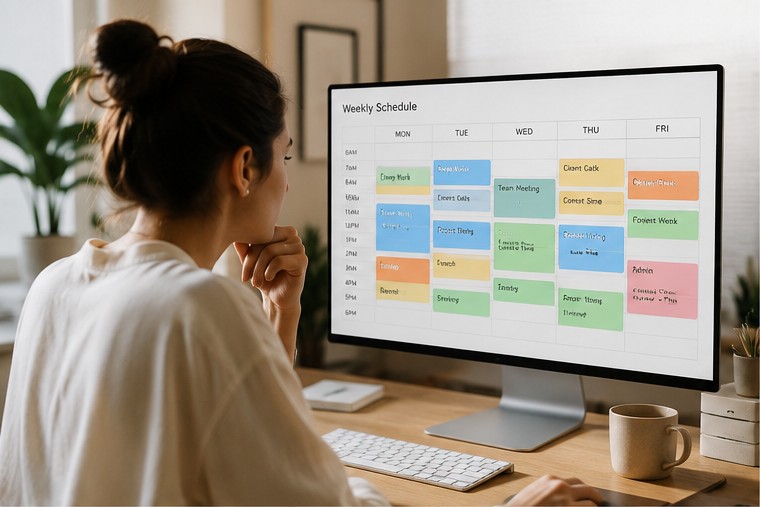
Here is what a blocked day can look like. From 8:30 to 9 you plan and review. From 9 to 11 you do deep work on your single most important project, phone on silent, no email. From 11 to 12:30 you take sales or customer calls. Lunch and a real break run to 1:30. From 1:30 to 3 you handle meetings and collaboration. From 3 to 4 you batch email and admin. From 4 to 4:30 you review and set up tomorrow, with the last stretch left as buffer for whatever ran over.
Notice the shape: hardest work when you are freshest, shallow work when you are not, and the day bookended by short planning rituals. The exact times do not matter. The structure does.
Tools That Make It Easier

You can time-block with a paper planner and a pen, and plenty of founders do. If you prefer digital, Google Calendar is enough to color-code blocks and set them to repeat. For automatic scheduling that reshuffles your blocks when meetings land, Reclaim and Motion both defend your focus time for you. To protect deep-work blocks from your own phone, an app like Freedom blocks distracting sites during the hours you choose. Start with the simplest tool you will actually open; the method matters far more than the app.
Why Founders Specifically Benefit
When you run the business, no one protects your time but you. Every person on your team, every customer, and every notification has a claim on your attention, and without a structure, the important-but-not-urgent work, the strategy, hiring, and product thinking, never gets its turn.
Time-blocking is how you pay yourself first with your hours. It also makes delegation obvious: once your blocks are visible, the tasks that keep crowding your calendar but do not need you are the exact ones to hand off or automate. If you are still figuring out which parts of the business to build around, mapping it in a simple plan first helps, and our guide to writing a business plan that actually gets used pairs well with a blocked calendar.
Common Mistakes to Avoid
The biggest one is over-packing the day. If you block all eight hours with zero slack, one delay topples the rest and you quit by Wednesday. Plan for about 60 to 70 percent of your day and leave the rest breathing room.
People also make blocks too vague. “Work on business” is not a block; “draft Q3 sales email sequence” is. Others abandon the system the first time a day goes sideways, when the real skill is simply re-blocking the remaining hours and moving on. And many underestimate everything, so track your actual times for a week and schedule from reality, not optimism.
How to Make It Stick
Do not overhaul your whole life on day one. Block just your two peak morning hours for the first week and leave the rest of the day as usual. Once protecting that window feels natural, extend blocking to the afternoon, then to weekly themes. A system you keep beats a perfect system you abandon, so build it in layers and give yourself grace when a day breaks the plan.
The Science Behind Why It Works
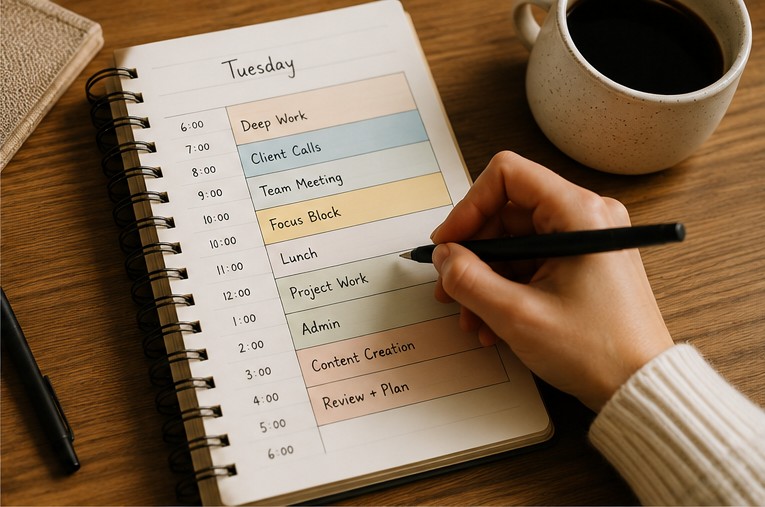
Time-blocking is not just a productivity fad; it works because of how attention actually functions. Every time you switch tasks, your brain pays a “switching cost,” a few minutes of reduced focus while it reloads context. Do that dozens of times a day, checking email between every task, and you lose a stunning amount of usable brainpower to friction alone.
Blocking eliminates most of those switches. When you know the next 90 minutes belong to one thing, your brain stops half-scanning for the next interruption and drops into deeper focus. Researchers call this state flow, and it is where your best and fastest work happens. You cannot schedule flow directly, but you can build the exact conditions that invite it, and protected blocks are those conditions.
There is a psychological benefit too. A blocked calendar removes decision fatigue. You are not repeatedly asking “what should I do now?”, a question that drains willpower every time you answer it. The decision is already made, so you just execute. Founders make hundreds of decisions a day, and taking the “what next” question off the table frees up mental energy for the ones that matter.
Weekly Theming: The Advanced Layer
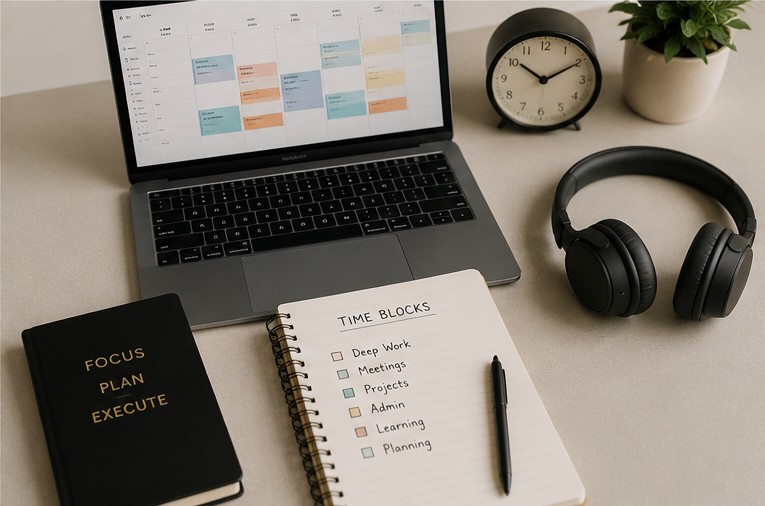
Once daily blocking feels natural, add day theming to reduce switching even further. Instead of scattering sales, product, and admin across every day, you dedicate whole days to a domain. Jack Dorsey famously ran two companies partly by theming his days, and solo founders benefit even more because they wear every hat.
A simple weekly theme might look like this: Monday for planning and strategy, Tuesday and Wednesday for deep project work, Thursday for meetings and partnerships, and Friday for admin, finance, and review. You will still handle small urgent items daily, but the bulk of each type of work lives on its own day. The payoff is momentum, because a full day inside one domain lets you go far deeper than five scattered one-hour attempts ever could.
Handling Interruptions Without Losing the System
The fear every founder has is that blocking is too fragile for the chaos of running a business. In practice, the system bends instead of breaking if you plan for interruption. Keep a “reactive” block, say 30 minutes twice a day, where you deliberately deal with whatever came up. Knowing that window exists makes it far easier to ignore a non-urgent ping at 10 a.m., because it has a scheduled home at noon.
Teach your team the rhythm, too. When people know you answer messages in batches at set times and that true emergencies still reach you, most “urgent” requests turn out to fit neatly into your reactive blocks. You are not becoming unavailable; you are becoming predictable, which is better for everyone, including you.
How to Know It Is Actually Working
Give the system two full weeks before you judge it, and measure the right thing. The goal is not a color-perfect calendar; it is whether your one to three high-impact tasks got real, focused time each day. At the end of the week, ask yourself a simple question: did the work that grows my business actually happen, or did it lose to the inbox again?
Track two quick numbers. First, how many of your planned deep-work blocks you protected versus how many got hijacked. Second, how you feel at the end of the day, scattered or satisfied. When those numbers move in the right direction, you will feel it as calm rather than chaos, and that feeling is the real signal that the structure is doing its job. If a block type keeps getting skipped, that is not failure; it is data telling you to reschedule it to a better hour or delegate it entirely.
Frequently Asked Questions
How long should a time block be?
For deep work, 90 minutes to two hours matches your brain’s natural focus cycle. For shallow tasks, 30 to 60 minute batches work well. Avoid blocks longer than about two hours without a break, since focus and quality both fall off.
What if meetings destroy my blocks every day?
Batch meetings into set windows, such as afternoons only, and mark your morning deep-work block as busy so no one can book it. Protecting even one focused block a day is a win worth defending.
Is time-blocking too rigid for a creative business?
It is actually the opposite. By scheduling protected creative time, you guarantee it happens instead of hoping inspiration finds a gap. The blocks create the space; what you do inside them stays as free as you like.
What should I do when a day falls apart?
Do not scrap the system, just re-block the hours you have left around the new reality. The goal is not a perfect day; it is a deliberate one. Re-planning on the fly is the skill that makes the habit durable.
How is time-blocking different from a to-do list?
A to-do list is a set of tasks with no time attached. Time-blocking assigns each task a specific slot on your calendar, which forces you to confront how much actually fits in a day and protects your priorities from everyone else’s.
You might also like: How to Write a Business Plan That Actually Gets Used · Best Business Bank Accounts for Freelancers and LLCs · 11 Realistic Side Hustles for Women That Actually Pay
Related Post